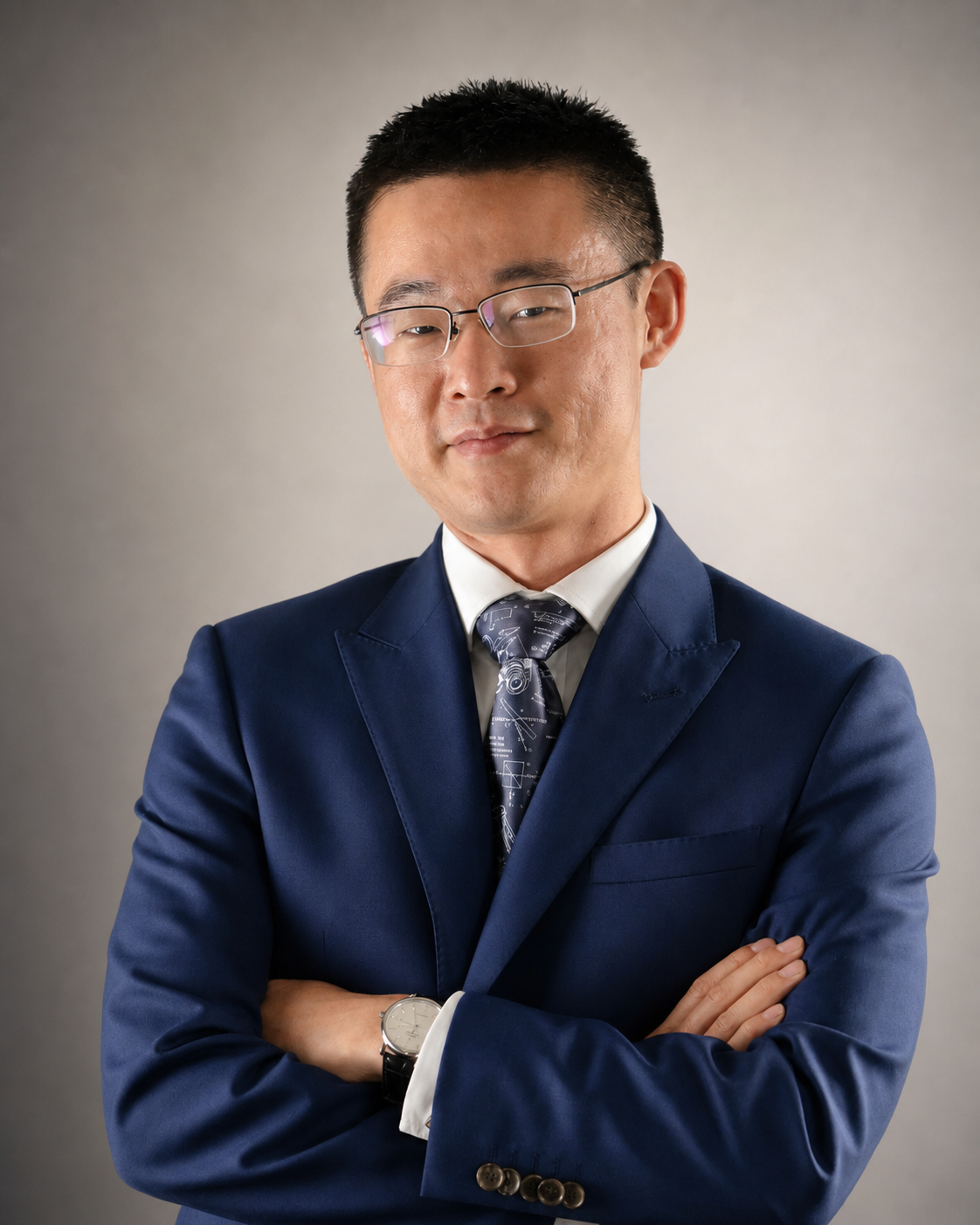
Xiaotian (Steven) Dai
Senior Lecturer (Associate Professor) · PI of ReFLEX Lab
Real-Time & Distributed Systems Group
Department of Computer Science
University of York
Office: CSE/136 · Email: xiaotian.dai (at) york.ac.uk
About Me
I am a Senior Lecturer (~Associate Professor) in the Department of Computer Science at the University of York, where I lead the Real-Time and Flexible Cyber-Physical Systems (ReFLEX) Lab within the RTDS Research Group.
My research focuses on modelling, scheduling, and timing analysis for cyber-physical systems, with an emphasis on making safety-critical systems more flexible, adaptive, and predictable. I also develop digital-twin techniques for feedback-driven runtime improvement and specialised hardware designs for real-time and embedded systems. This work has been applied across robotics and autonomous systems, self-driving, avionics, control systems, 5G base stations, and transportation, with a focus on operational safety, robustness, and resilience. You can find more about my research interests and projects on the research page.
Short Bio: I first joined the Real-Time Systems Group at York in 2015 as a PhD student supervised by Prof. Alan Burns, completing my degree in 2019 with a Best Thesis award. Before taking up my lectureship in 2023, I worked as a Research Associate on the MOCHA research project (2019-2023), developing digital-twin and cache-aware scheduling techniques for many-core architectures in next-generation 5G/6G communication base stations, and contributed to the EU Horizon 2020 DEIS project on model-based safety assurance for autonomous and cyber-physical systems.
Track record: I have published over 30 peer-reviewed papers, with more than 600 citations and an H-index of 13 as of 2026. I regularly serve as a Technical Program Committee member and reviewer for leading conferences and journals in real-time embedded systems, robotics, and design automation, and I also act as an external reviewer for UKRI funding.
Other links:
- Looking for PhD opportunities?
- Real-time, embedded, and robotics systems conference tracking
- My robotics projects
- My amateur photography portfolio.
News
- service Oct 2026: Invited as a TPC member and Publication Chair of RTAS 2027.
- grant Oct 2026: Our cross-cutting project on drone swarms for fabric manipulation (D-FAB) was funded by the Institute for Safe Autonomy (ISA).
- service Sep 2026: Invited as a TPC member of AEiC 2027.
- paper Aug 2026: Our paper “PAPS: A Predictable and Adaptive Priority Scheme for Tasks with Variable Data Latency” is accepted at RTSS 2026!
- grant Aug 2026: Our proposal on adaptive robotics for XR lighting effects (RAVEN-SCAR) was granted (£20k).
- paper Aug 2026: Two workshop papers “RAVEN: A Latency-Aware Predictive Digital Twin Framework for Humanoid Robotic Cinematography in Virtual Production” and “Adaptive Decentralised Coordination Algorithms for Autonomous Swarm Robots in Planetary Surface Missions” are accepted at TAROS 2026!
- paper Jul 2026: Our paper “Reliable Resource Sharing and Analysis for Multicore Mixed-Criticality Systems” is accepted at IEEE Transactions on Computer-Aided Design of Integrated Circuits and Systems (TCAD)!
- paper Jun 2026: Our paper “CAFT-RS: Fault-Tolerant Resource Sharing Protocols with Diverse Preemption Schemes” is accepted at IEEE Transactions on Parallel and Distributed Systems (TPDS)!
- paper May 2026: Our paper “When Memory Matters: An Evaluation of LSTM-Based Multi-Agent Learning for Multi-Intersection Traffic Signal Control” is accepted at ITSC 2026!
- paper Mar 2026: Our paper “Beyond Exact: Tight WCET Analysis of GPU Kernels with Branch Divergence” is accepted at DAC 2026!
- service Feb 2026: Invited as a TPC member of RTCSA 2026.
- service Jan 2026: Invited as a TPC member of EMSOFT 2026.
- service Jan 2026: Invited as a TPC member of RTNS 2026.
Please visit News for more news.